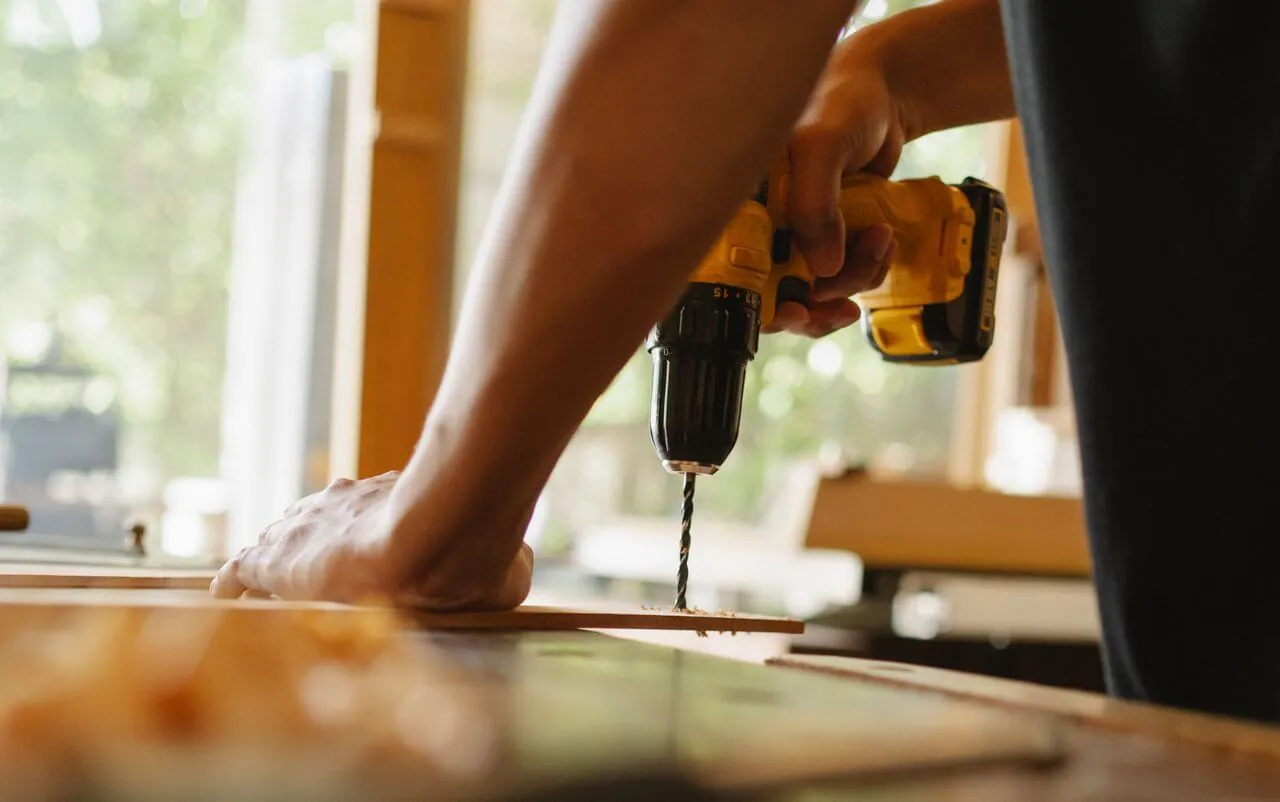
Blind fitting in Fulham: what the job involves
Fitting a blind looks simple, but most of the work is measuring and marking. The first decision is inside or outside the recess. The recess is the opening set into the wall around the window. Blinds inside it look neat and let you keep the window board clear. Blinds outside it, fixed to the wall above, block more light and hide an uneven opening.
Then the brackets are marked out level, drilled and fixed, the blind is clipped in and tested, and any cord safety parts are fitted. With several windows in one room, we line the blinds up with each other as well as with the windows, so they all sit at the same height when lowered.
Our blind fitting in Fulham covers roller, roman, venetian, vertical and pleated blinds, plus curtain poles, tracks and voile wires, and we also work in Parsons Green, Putney and Chelsea.
Sash windows, bay windows and tall rooms
Sash windows bring their own puzzle. A blind inside the recess has to clear the catch in the middle and the lifts on the bottom sash, or it will snag every time it comes down. We check the depth before you order, which saves an expensive mistake with made to measure blinds.
Many period terraces have bay windows, and blind fitting in Fulham often means working around one. A bay can take separate blinds in each section, or a curtain track bent to follow the shape of the bay. Bay poles with angled joints are another option. The angles in older bays are rarely equal, so each one is measured on its own.
Victorian and Edwardian ground floor rooms often have tall ceilings and tall windows. Full length lined curtains for those windows are heavy, and the pole needs strong fixings and often a centre bracket to stop it bowing.
Jobs we cover
- Roller, roman, venetian, vertical and pleated blinds
- Curtain poles, tracks and voile wires
- Bay window poles and bent tracks
- Blinds inside sash window recesses
- Child safety cleats, tidies and tensioners
- Measuring before you order
- Taking down old poles and blinds and filling holes
- Refixing poles that have pulled out of the wall
Fixing into old plaster, brick and plasterboard
The wall just above a window is often the trickiest place in the house to drill. There is usually a lintel, the beam that carries the wall over the window opening. In older houses it may be timber or stone, and in later alterations it may be concrete or steel. Each needs a different drill bit and fixing, and steel can mean using the frame or the wall to the sides instead.
Plaster in older homes can be soft and crumbly around windows, and LABC notes that most pre 1930s houses have lath and plaster ceilings, which matters if you want a ceiling fixed curtain track. Converted flats often have plasterboard reveals and ceilings, which need cavity fixings or a fixing into the timber behind.
If the plaster around the window has a swirled or stippled textured finish, tell us before the visit. HSE says asbestos can be found in any building built before 2000 and has specific guidance on drilling through textured coatings.
Blind cords and child safety
Looped cords and chains on blinds can be dangerous for young children. Government guidance on gov.uk says new blinds with looped cords must have child safety devices fitted when made, or supplied with the blind. Cleats, the small hooks you wrap the cord around, should be fixed out of reach at least 1.5 metres from the floor. Cord tidies and tensioners should be fixed firmly so the cord or chain stays tight.
We fit these parts on every blind fitting job in Fulham and can add them to older blinds that never had them. The same guidance says to keep cots, beds, high chairs and play pens away from blinds, so think about where the furniture will go in a child's room before the blind goes up.
Flats, mansion blocks and rentals
Your lease sets out the conditions you agreed to, so if your block has rules about how windows look from outside, they will be in there or available from your managing agent. In a rental, ask your landlord before new holes go in the walls.
Landlords often ask us to replace broken or stained blinds between tenancies. Simple white roller blinds inside the recess are hard wearing and easy for the next tenant to live with.
What to have ready
If you have not ordered yet, we can measure first as part of your blind fitting in Fulham, so the blinds fit properly.
- The blinds, poles or tracks with all their brackets and screws
- A decision on inside or outside the recess for each window
- Photos of each window, including the top of the frame
- The window board clear of plants and ornaments
- Landlord permission if you rent
Common problems with blinds and poles
A pole that sags in the middle needs a centre bracket. Brackets that have pulled out of the wall usually went into crumbly plaster with short plugs; refixing them with longer fixings into the brick or lintel behind normally cures it. Blinds that hang crooked are often fixed to a window frame that is not level itself, so they need setting to a level line rather than to the frame.
Made to measure blinds that turn out slightly too wide for the recess are another regular one. Recesses in old houses are often narrower at the top than the bottom, so measure at the top, middle and bottom and use the smallest figure.
Who this suits
- Owners of terraced houses with bay or sash windows
- Families with young children who need safe cords
- New buyers dressing windows before moving in
- Flat owners with tall windows in mansion blocks
- Landlords replacing blinds between tenancies
Common questions
Should I measure the windows before ordering blinds?
If you are confident, yes, but old window recesses are rarely square. Measure the width at the top, middle and bottom and use the smallest figure. If in doubt, ask us to measure first.
Inside or outside the recess: which is better?
Inside looks neater and leaves the window board free. Outside blocks more light and suits recesses that are shallow, uneven or full of window catches. Sash windows often need a check on depth before you decide.
Can you fit a curtain track to my bay window?
Yes. Tracks can be bent to the shape of the bay, or you can use a bay pole with angled joints. Each angle is measured on site because older bays are rarely symmetrical.
Can you make my old blinds safe for children?
Yes. We can add cleats fixed at least 1.5 metres from the floor, or cord tidies and tensioners that keep the cord tight, in line with government guidance on gov.uk.
Can you fit motorised blinds?
Battery and rechargeable motorised blinds can be fitted like any other blind. If a blind needs wiring into the mains, that part is electrical work, so we plan it as a separate electrical job.
My curtain pole keeps coming away from the wall. Can you fix it?
Usually. The brackets are often in soft plaster with short plugs. Refixing with longer fixings into the brick or lintel, and adding a centre bracket, normally solves it for good.
Can you take down the old curtain pole and fill the holes?
Yes. We remove the old brackets and plugs, fill the holes and sand them ready for paint, then fit the new pole or blind.